
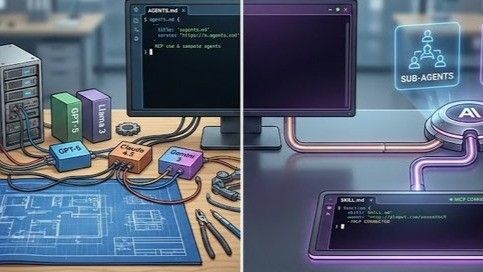
A comparison of two of the most well-known and widely used AI coding agents. This is a critical guide for Enterprises looking to introduce AI coding agents into their development workflows.
The AI coding agent landscape is currently dominated by two distinct philosophies: one focused on open flexibility, the other on speed and reasoning precision.
In this breakdown, we compare OpenCode (by Anomaly Innovations Inc., creators of SST and OpenTUI) and Claude Code (by Anthropic) to help your engineering teams choose the right framework.
1. Core Philosophy & Vendor Lock-In
OpenCode: Fundamentally model-agnostic and open-source. It treats the AI model as a swappable component. You can use Claude Opus 4.5, GPT-5.2-Codex, Gemini 3, or even local models via Ollama. It is designed for developers who want to bring their own API keys (BYOK) and avoid being tied to a single provider's pricing or infrastructure.
Claude Code: A first-party tool optimized specifically for the Anthropic ecosystem. While it is the "gold standard" for reasoning and speed within the terminal, it is strictly tied to Claude models. If a better model launches from a competitor, you cannot simply "switch" the engine inside the CLI.
2. Architecture and Capabilities
OpenCode:
Client/Server Architecture: Written in Go, it decouples the UI from the execution. You can run the OpenCode Server on an AWS instance (e.g., 100GB RAM) and connect to it from a lightweight laptop. This enables persistent sessions that stay alive even if you close your terminal.
Hybrid Interface: While primarily a terminal tool, running
opencode webspins up a localhost dashboard to visualize complex diffs and manage active background agents.Multi-Provider Strategy: Route "easy" logic tasks to cheaper models (e.g., GPT-5 mini, Gemini 2.5) and "heavy" architecture tasks to
claude-4.5-opusto optimize costs.
Claude Code:
Agentic Search: A Node.js-based CLI optimized for "terminal velocity." It excels at using bash tools (
grep,find) to explore codebase topography on the fly.Sub-Agents: Introduces hierarchical workflows. A main agent can spawn Sub-agents to perform tasks in parallel (e.g., one agent maps dependencies while another writes tests), drastically reducing time for complex refactors.
Agent Skills & MCP Support: Natively supports the Model Context Protocol (MCP). You can plug Claude Code directly into PostgreSQL, Sentry, or GitHub. Example: "Claude, check Sentry for the latest auth error and write a fix."
3. Configuration & Extension
When it comes to extending the capabilities of these agents, the two platforms take different approaches:
| Feature | OpenCode | Claude Code |
|---|---|---|
| Project Context | Uses AGENTS.md (an emerging open standard for AI context). |
Uses CLAUDE.md for project-specific rules and guidelines. |
| Customization | Custom commands, SDK integration, and TUI theming. | Skills (lazy-loaded workflows in SKILL.md) and Hooks (automated triggers like pre-commit). |
| Tooling | MGrep (4x faster grep) and direct LSP (Language Server Protocol) support for semantic understanding. | MCP (Model Context Protocol) for native connections to external tools (Postgres, Sentry, GitHub). |
| UI | Rich Terminal UI (built with BubbleTea) + a local Web Dashboard. | Minimalist CLI for high speed + a Cloud-based Web Environment. |
4. Enterprise & Security
OpenCode Enterprise: Designed for "Zero-Trust." Offers SSO integration and an internal AI gateway. Because it is open-source, you can audit the entire execution loop—critical for high-security environments requiring on-premise models.
Claude Code: Relies on Anthropic’s managed security. It provides interactive permission prompts for every file write or command, which some find "chatty" but others value for safety.
5. Pricing & Realistic Utility
OpenCode is the "economical" choice. You pay for the infrastructure (if self-hosting the server) and the raw API tokens. It is generally cheaper because you can mix-and-match models. The open-source tier is truly free.
Claude Code is the "premium" choice. It requires a Claude Pro or Max subscription and can be "token-hungry" due to its detailed reasoning steps. You need an Anthropic Console account. The usage of Sub-agents and Deep Reasoning (thinking steps) can burn through tokens rapidly. A complex refactor session might cost $5-$10 in a single afternoon, whereas OpenCode allows you to control costs by swapping to cheaper models for simpler tasks.
Verdict: Which one to choose?
Use OpenCode if:
You fear lock-in: You want your workflow to survive regardless of whether Anthropic, OpenAI, or Google is currently "winning."
You need custom architecture: You want the AI to run on a remote server while you type on a mobile or lightweight laptop.
Security is paramount: You need to audit every packet and perhaps run open-weight models (Llama/Mistral) on-premise.
Use Claude Code if:
You want "Magic": You want the smoothest, most "intelligent" experience where the tool acts like a senior engineer with access to your entire SaaS toolchain (via MCP).
You want Enterprise simplicity: You already pay for Claude Enterprise and want seamless integration with your existing billing and legal agreements.
Speed of Setup: You want to run
brew install --cask claude-codeand start coding in 30 seconds without configuring providers.
Ready to Scale AI in Your Engineering Workflows?
Choosing between OpenCode and Claude Code is just the first step. Successfully integrating these tools across a 500+ person engineering organization requires secure gateways, localized context (RAG), and strict observability.
At Qubitly Ventures, we specialize in helping enterprises securely adopt and scale AI coding agents without sacrificing compliance or developer velocity.
Stop guessing and start executing. Contact Qubitly Ventures today to request an engineering readiness assessment and implementation blueprint.