
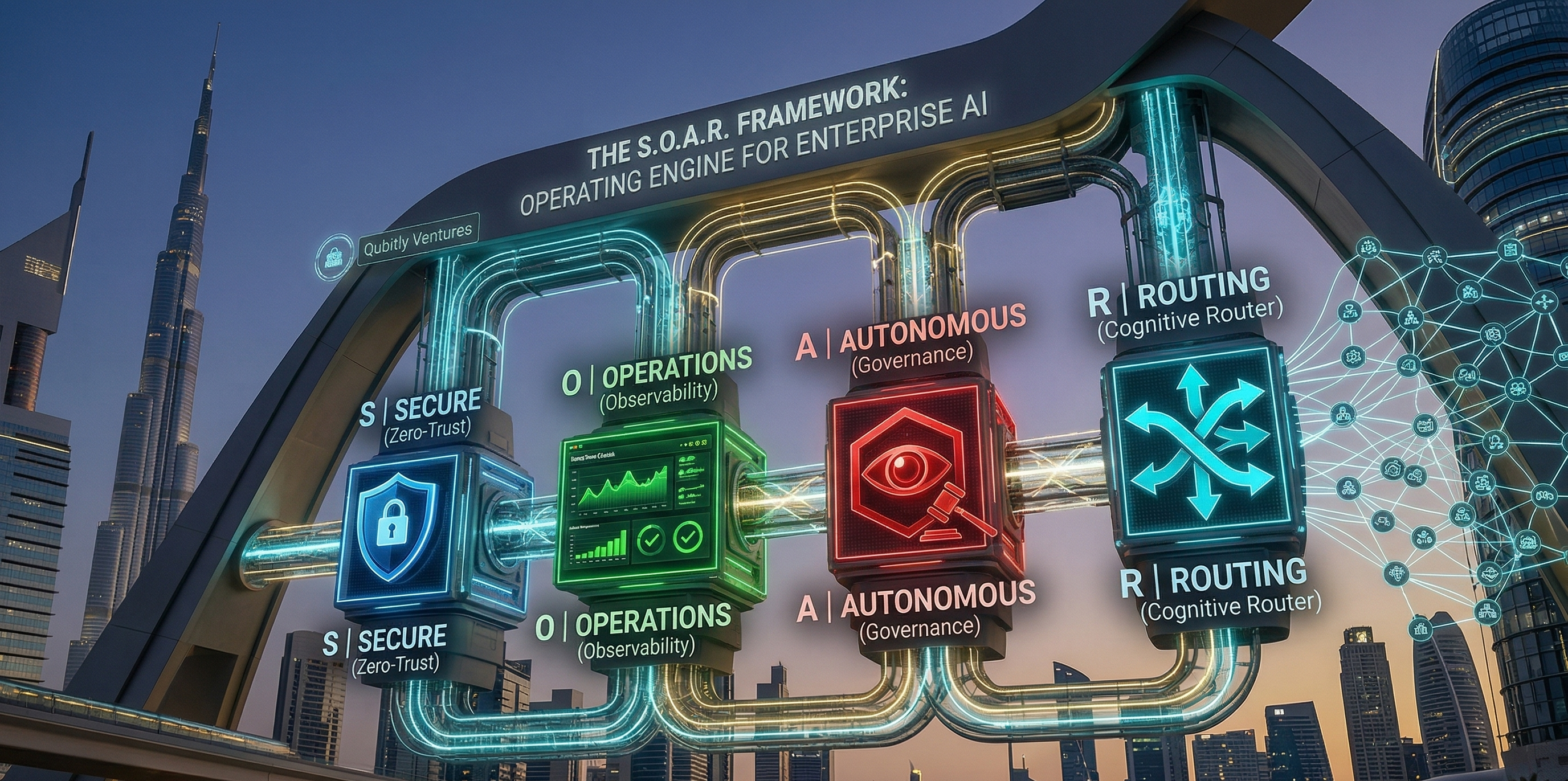
The S.O.A.R. (Secure Operations & Autonomous Routing) Framework is a comprehensive blueprint designed to help enterprises scale multi-agent AI with absolute confidence, guaranteeing data privacy, strict governance, and measurable ROI at every step.
The AI proof-of-concept era is over. Across the global enterprise landscape, companies are discovering a frustrating reality: moving artificial intelligence from a controlled pilot to a live customer-facing operation is far harder and far more dangerous than it first appears.
Gartner recently warned that up to half of all Generative AI projects will fail before ever reaching production. The barrier is rarely computing power or a shortage of compelling use cases. The barrier is governance, liability, and unit economics.
When organizations attempt to deploy standard Large Language Models into high-stakes customer service or operational workflows, they collide with the same three pain points, over and over:
- 01. The Data Privacy Vulnerability: Exposing proprietary business logic or Personally Identifiable Information (PII) to a third-party API is not a technical oversight — it is a critical compliance violation with direct legal and reputational consequences.
- 02. The Coordination Crisis: The industry consensus is clear - enterprise AI has moved past a generation problem and into a severe coordination problem. Non deterministic AI cannot handle the multi-step, context-dependent workflows that enterprise operations demand.
- 03. The Financial Black Box: C-Suites are funding AI initiatives without the telemetry to measure real value. Without token-level cost tracking and direct revenue attribution, AI remains an expense line - not a business asset.
"The difference between a failed AI experiment and a transformative operational engine is the architecture beneath it."
To bridge the gap from conversational novelty to a secure operational engine, enterprises need more than a better prompt. They need a paradigm shift in how AI systems are architected.
At Qubitly Ventures, we developed a proprietary methodology built specifically for this challenge. We call it the S.O.A.R. Framework.
What is S.O.A.R.?
S.O.A.R. stands for Secure Operations & Autonomous Routing. It is an architectural blueprint designed for highly regulated environments that moves the enterprise away from a single, fragile LLM prompt and toward a distributed, heavily governed multi-agent system. Each of the four pillars directly addresses one of the core failure modes of standard AI deployments.
S | Pillar One: Secure - Zero-Trust AI Architecture
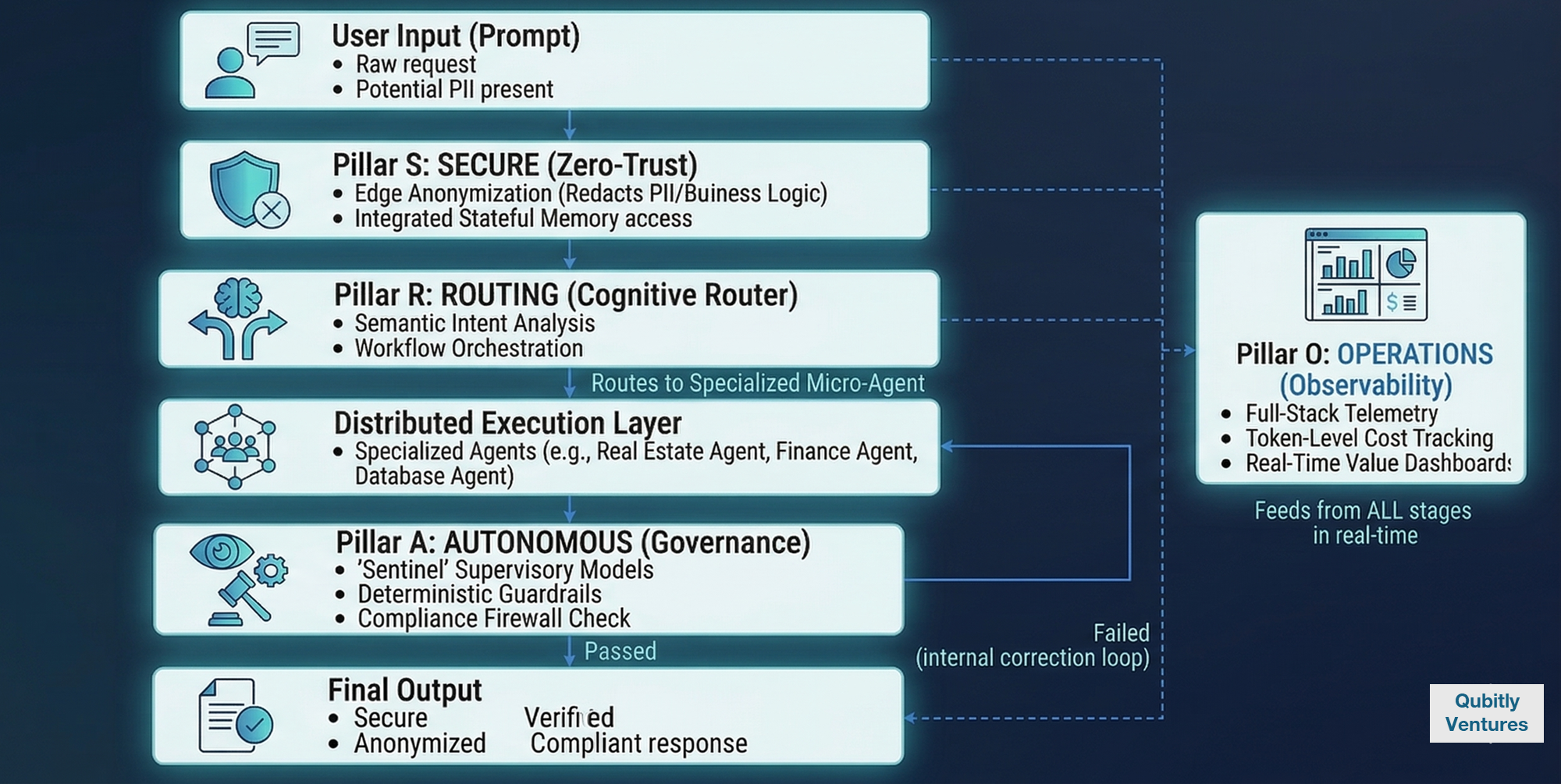
A fundamental principle of modern security is that AI agents cannot be given a master key to enterprise infrastructure. Raw user data must never flow directly to a monolithic model. Under the S.O.A.R. framework, all interactions are anonymized at the edge before they reach any model. To ensure the system still feels personal and contextually aware, we integrate stateful, vectorized memory - a mechanism that securely retains long-term semantic context across multiple sessions without ever exposing PII. The result is an AI that operates with precision and personalization while remaining strictly compliant with global data privacy regulations including GDPR.
O | Pillar Two: Operations - Full-Stack Observability & AI Value Metrics
You cannot scale what you cannot measure. Gartner emphasizes that establishing concrete AI value metrics is the only way to justify continued investment. S.O.A.R. treats AI as a measurable business unit, not a cost center. We integrate comprehensive, dual-layer telemetry directly into the core of the engine. The engineering layer provides deep architectural tracing - latency, API reliability, agent call paths. The business intelligence layer feeds live dashboards with real-time unit economics: token-spend per anonymized user, deterministic compliance rates, and exact cost and revenue per interaction. For the first time, the C-Suite gains genuine financial visibility into what AI is actually doing.
A | Pillar Three: Autonomous - Deterministic Guardrails & Agent Governance
Standard prompting alone cannot eliminate hallucinations. IBM's latest research underscores the critical need for formal AI agent governance frameworks. S.O.A.R. implements active, deterministic guardrails governed by autonomous supervisory agents - what we call "Sentinel" models. Before any AI-generated output reaches a customer, these specialized agents execute self-reflective peer reviews and trigger automated internal correction loops. Every single response must pass a compliance firewall before egress. Brand safety is not aspirational - it is mathematically enforced.
R | Pillar Four: Routing - Dynamic Agentic Orchestration
Standard chatbots force a single, expensive model to process every request - regardless of complexity. This drives up compute costs, increases latency, and degrades response quality as context windows fill. S.O.A.R. replaces this with a distributed network of specialized micro-agents. A front-line cognitive router analyses each incoming message for semantic intent, then dynamically orchestrates the workflow - routing the user to the precise downstream agent best suited for that task. This "divide and conquer" approach reduces latency, prevents context degradation, and fundamentally optimizes enterprise compute costs at scale.
Why S.O.A.R. Systems are the Future of Enterprise AI
The shift from non deterministic AI application to a governed multi-agent system is not an incremental improvement. It is a categorical one. In a single-model deployment, every failure mode compounds: a hallucination, a PII leak, and an unexpected cost spike can occur in the same interaction. In a S.O.A.R. system, each layer of the architecture has a single, auditable responsibility.
The security layer never sees unredacted data. The Sentinel layer never lets a non-compliant response reach the customer. The routing layer never sends a complex query to a model not built for it. And the observability layer records all of it, so teams can continuously improve.
The enterprise AI coordination problem is real - but it is solvable with the right architecture.
📊 See S.O.A.R. in Production
Read the Tri-Market Real Estate Case Study to see exactly how the S.O.A.R. Framework handles multi-region compliance, autonomous database lookups, and executive observability in a live, high-stakes deployment across the UAE, UK, and Singapore.
👉 Read the Case Study
The technology to automate complex, high-risk customer operations — without multiplying legal liabilities - already exists. What most organisations lack is not ambition. It is the architectural discipline to deploy it responsibly.
If your enterprise is ready to move beyond basic wrappers and deploy secure, fully observable AI systems that protect your brand and generate measurable revenue, it is time to stop experimenting and start architecting.
Write to us at: contact@qubitlyventures.com